- Level 2
- Ages 4-8
- 6 steps
How to draw an elephant, easy step by step
6 easy steps for ages 4-8. Watch it, trace it, draw it on your own and get a shape match score, then colour it in. Free printable and certificate.
Drawing is best with a finger or a pencil on a tablet or phone
Scan the code with the tablet's camera to open this page there. You can also use the mouse here, or print the free elephant drawing sheet and use a real pencil.
1Watch it
See the elephant drawn one step at a time. The new part is orange.
Press play and watch the elephant being drawn, one step at a time. Then try it yourself below.
2Trace it
Follow the grey lines with your finger or a pencil. Start at the green dot for each part: 1 is the head. Then press Check.
The score is worked out on this device. Nothing you draw is saved or sent.
3Draw it on your own
No lines to follow this time. Draw the elephant big, then press Check for your shape match score. It looks for each part and where it is.
Look at the elephant, then draw it big in the box.
The score is worked out on this device. Nothing you draw is saved or sent.
4Make it yours
Colour your elephant any way you like. Tap a shape to fill it, or use the brush to add stripes, spots and a background. No score here.
Tap inside a shape to fill it. No score here: every elephant is right. Add stripes, spots, a hat, a background, anything you like. Your picture stays on this device.
5Print it
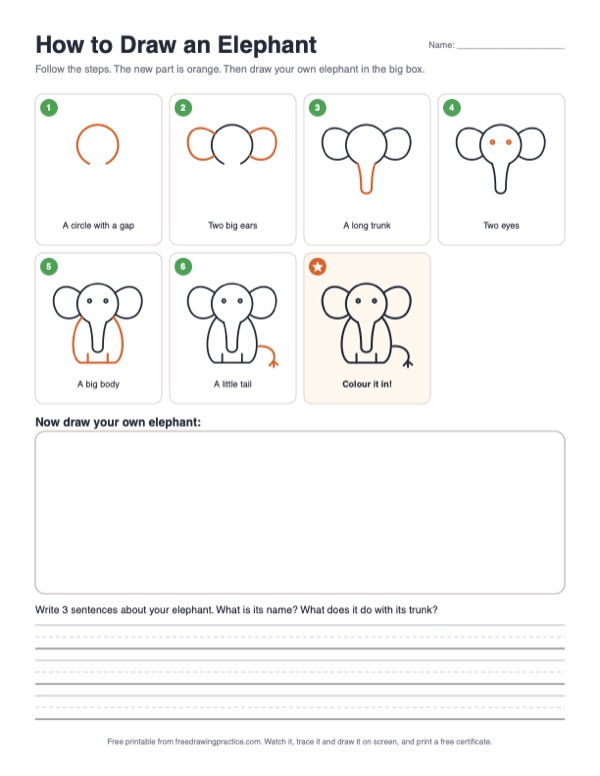
A free drawing sheet with all 6 steps, a big box to draw your own elephant and lines to write about it. And a certificate with your child's name.
Free printable PDF
Free certificate
Type your child's name and print a certificate for the fridge. Made on this device: the name is not sent anywhere.
How to draw an elephant: the steps
Step 1. Draw a circle for the head, but stop before you close it. Leave a gap at the bottom for the trunk.
Step 2. Draw a big floppy ear on each side of the head.
Step 3. From one side of the gap, draw a line down, go round the bottom and come back up to the other side.
Step 4. Draw two dot eyes on the head.
Step 5. Under the head, draw a big U shape for the body. Add two short lines at the bottom for the legs.
Step 6. Last, draw a thin tail on the side with a little brush on the end. Your elephant is done!
Tips for parents and teachers
- Elephants are grey, but nobody has to tell the pencil. Let your child pick any colour in step 4.
- A finger works fine on a phone or tablet. A pencil or stylus is better: the line gets thicker when you press harder.
- The score only checks how close the shape is to the model elephant. Wobbly lines are fine. Always finish with step 4, where there is no score and every elephant is right.
- In class: draw the elephant together, then ask children to write three sentences about it on the printable. Good for morning work and early finishers.
Questions
What is the easiest way to draw an elephant?
Draw a circle for the head, but leave a gap at the bottom. Add two big ears, then a long trunk hanging down from the gap. Draw two eyes, a big body and a little tail. That is all 6 steps on this page.
Which part of the elephant is hardest to draw?
The trunk. It starts wide at the head and gets a little thinner on the way down. Draw one side down, go round the bottom, and draw the other side back up.
How can my child make the elephant their own?
Add two small tusks next to the trunk, or let the trunk spray water. Make the ears even bigger. In step 4, add toenails and some grass.
What age is this for?
Ages 4-8. Younger children can trace it with a finger; older children can draw it on their own and try to beat their shape match score.
How does the shape match score work?
When your child presses Check, the page compares the lines with the model elephant: are the head, ears, trunk, body and tail there, and in about the right place? It runs on your device. The drawing is never uploaded or saved.
Do I need a stylus?
No. A finger is enough. A pencil or stylus (like an Apple Pencil) is nicer because the line follows how hard you press. On a computer you can use the mouse, or print the PDF and draw with a pencil.
Is it really free?
Yes. The lesson, the printable PDF and the certificate are free, with no sign-up and no ads.
More to draw
Practising letters too? Try the free tracing on FreeHandwritingPractice.